I (sometimes) call myself Mr. Pondersome. I'm a rather wordy, weirdy person. I say hullo a lot. I write a lot more. While you're here, why not give some of it a read?
Showing posts with label non-fiction. Show all posts

Thursday, 4 March 2021

The Fluffy Book Above the Pool (a.k.a. A Textured Anecdote for World Book Day)


During my early work days, I attended a course to become a Reading Friend. This was held at a local sports centre.

In order to get to the session, we had to notify the front desk and then turn abruptly up an unexpected stairwell. As I ascended, the lights became more artificial and the smell of sweat and chlorine was smothered by lavender carpet cleaner.

When I arrived at the necessary floor, I had to cross a long thin burgundy walkway with windows on the left, looking down on the swimming pool below. Every now and then, I turned to observe a hasty splash of some childish swimmer, hoping to startle an adult who was focusing hard on her butterfly stroke.

At the end of the walkway was a conference room with white tables, at the centre of which sat a man and a woman amid an assortment of board books and picture books. The most important book of all was at the centre: the one in which we signed our attendance.

Throughout the two-hour session, the man and woman held up different books and showed how to coax the interest of a young child, the importance of asking questions about what they think might happen next and drawing attention to the background detail of the consistently impressive illustration. Then, when they both ran out of puff, the man and the woman told us to turn to the person immediately to the right of us and practice. Pretending that another grown-up was a baby was immensely weird until you had to be the baby yourself. I had fun with it until I heard myself actually say, ‘goo-goo ga-ga’.

Then after a quick and energetic feedback, the man and woman brought out the pièce de résistance: a pink fluffy board book. This was to show the tactile nature of reading with babies and how it helps early development. We all got to stroke the woolly cover and flip a couple of fabric pages before hastily passing it on, fearing that a thorough inspection might seem like outright fetishism. It was just a shame that the dyslexic teenagers I would be dealing with wouldn’t benefit from such soft tomes.

Once everyone had tickled their fingertips with book fluff, the man and woman moved the precious touchy-feely book out of sight, never to be used again. When I left the session, I glanced under the table and noticed a thin metal case between them, the kind you expect to carry precious cargo. I imagined the book inside, strawberry-scented wool and feathers pressed between two pads of protective foam.

Years later, after working in libraries, I learnt more about tactile baby books and how well they last. A metal case isn't nearly enough.


Thursday, 15 October 2020

Horror Anthologies for Great Causes (a.k.a. Making Use of the Darkness)


While in lockdown I've been fairly productive. 2020 is my Year of Horror Anthologies and how appropriate it is that they're both available by Halloween!

The first book is Darkness: An Anthology of Dark and Twisted Tales from Twisted Fate Publishing. It is a collection of stories ranging from unsettling science fiction to dark fantasy, two of which are mine. I collaborated with six other talented writers and contributed to the editing process.

All proceeds go to the Mind in aid of men's health.

You can find the relevant Amazon link here

The second book is It Came From the Darkness (noticing a pattern here?) from Red Cape Publishing and Phillip Rogers PR 101. It is an even bigger collection of horror flash fiction, all using the title for the first line of their work. I only have one story in this but it's a little bit different.

All proceeds go to the Max the Brave Fund.

You can find the relevant Amazon link here

So that's some of my dark side in print! At least it's for a worthy cause...😉

Saturday, 3 October 2020

Idle Pretention (a.k.a. Learning from My Lazy Student Days)

 After a bit of a tidy-up, my Mum found this sheet.


Holes with Flaps was a story that I wrote during my time at university. It was part of a flash fiction collection that I submitted for a short story module.

            The story itself is curious but re-reading the rather faint pencilled comment from the marking tutor really struck me. For one thing it is a rather generous critique for a flimsy and thematically embarrassing piece of writing but it also includes two words that have followed me around for many years. These are ‘poignant’ and ‘ambiguous’.

            ‘Poignant’ is one of my favourite adjectives to describe anything that makes me go hmm. Unfortunately it took me a couple of years to actually learn its precise definition, which is a strong and often sad effect of feelings. Here I was thinking it meant incredibly intelligent. Must have got it mixed up with ‘profound’.

            Nevertheless I have always intended to write stories that are poignant and profound. This is a foolhardy endeavour but has taken me just over a decade to realise the fact. I had an inkling as far back as 2010 that what I was putting to paper wasn’t quite as clever as I hoped it would be. Indeed my love of quirks and gimmicks in fiction doesn’t necessarily lend itself well to writing in the styles of Raymond Carver or Alice Munro. I tried regardless and had some occasional successes, Holes with Flaps not being one of them. Prior to rediscovering this sheet, I had all but forgotten the story.

            The other adjective ‘ambiguous’ is precisely the reason why these stylistic experiments rarely worked. Not enough meat on the bone. At university I learnt that the coolest short stories were the ones that were plain-speaking with short punchy sentences that only highlighted details the reader absolutely needed to know. I came to overlook the nuance of clear character development and mood-changing setting description. I neglected playing with a unique idea over multiple paragraphs, for fear that explanation would counteract a Hemingway-like honesty.

            While ambiguity was the common complaint, only I knew what it really was: laziness. Pure and simple sloth. I didn’t want to put in the hard work to make a story truly meaningful and memorable, I just wanted it to stand out. And it did though usually for all the wrong reasons. Oh sure, there was a poignance to some of those stories but it lacked depth and definition. In fact, you could say that there was a big ambiguous hole in my stories that was disguised with a thin flap of poignant expression.

            Now it’s not for me to say if I have developed much as a writer since then but I like to think I pad my stories better. If there are any conceptual tears, I try to sew them up and hide the stitching. It’s a lot of work but worth it. With every story I write now, I actively move away from idle pretention. It would be lovely one day to write something that combines gimmick, genre, philosophy and simplicity; something that sticks in a reader’s mind. Still that could take years. Another decade perhaps.

            Once upon a time I persevered blindly. I genuinely thought that stories like Holes with Flaps were erudite and enlightened. Since then I have added observation and self-awareness to that perseverance. I still create tales that fail to connect but I learn from them. That is the wonderful thing about keeping on with creativity through one’s life. You slowly shrug off idle pretention and grow up.

Wednesday, 24 June 2020

Out in the World with a Chunky Blue Jotter (a.k.a. What Actually Happens When You Write in Public Places)


Pub

I grabbed a seat in a busy pub and waited for a friend. He wasn’t late, I was early. Still I was concerned we wouldn’t be able to hear each other over the laddish din. Even the short bar stools were occupied by people spilling their pints on the varnished circular tables.
            Across from me sat three lads sharing a phone. One in a maroon rugby jersey was holding off about some ‘fat bird’ he knew in his nasal Geordie accent. He thumped the shoulder of the lad who was holding the phone, seemingly just for the hell of it.
            By this point I had taken out my chunky blue jotter and was distracting myself with a jokey story about the Trolley Problem.
            It took the Geordie lad a moment to notice this. “Harry Potter over here,” he muttered. He meant the glasses as that was the only similarity between me and the boy wizard.
            “Hey, mate,” he said. “What you writing?”
            “Something for work,” I lied.
            “What’s it about though?”
            “Nothing of interest.”
            Though he still had on his open mouth smile he clearly wasn’t happy with that answer. “Seriously though, what you writing?”
            I paused and looked him in the eye. “Work, you know?”
            He would have asked a third time had the phone holder not thumped him back. It occurred to me the Geordie lad thought I was writing about him and his mates or maybe even the ‘fat bird’ they just had been discussing. Perhaps I should have been more open and honest but I really wasn’t in the mood to justify myself to a nosy bar fly.
            My friend arrived shortly after that and supplanted himself between me and Geordie lad who had fortunately lost all interest. He announced to the whole pub that they would move on to a nearby alehouse and make a proper night of it. I was glad to see him go.
            A frustrating experience but, most frustrating of all, I didn’t get back to my story. The Trolley Problem had run away without me.

Café

I hid away in a café that itself was hiding from the high street. I settled at a granite top table beside an oak staircase and ordered a hot chocolate with all the trimmings.
            Having brought my chunky blue jotter, I started outlining a plan. The idea was thin, about a printer that printed dreams, but I made it work with two creative characters. Sometimes that’s all it takes to be inspired.
            The short blonde manager in a comfortable green hoodie stood behind the counter's cake display and grinned warmly at me. “Are you a writer by any chance?”
            “Yes.”
            “Is it a dissertation?”
            “No. I’m not a student.”
            “Oh. So you’re a creative writer?”
            “Yes.”
            “Excellent.” She seemed genuinely pleased. “Well, I’ll leave you to it.”
            Such interruptions can put me off my stroke but not that day. The sun was shining and the background chatter was moderate. Soon enough I had finished the plan and had started the story itself.
            A meeting broke up and a tall black-suited man with thinning brown hair stopped beside me.
            “Sorry to bother you but I’ve never seen anyone write so fast before.”
            “Thanks.”
            “Well. You do remind me of a lad I used to know. He had fast penmanship too. Hand-wrote his entire dissertation. Is that what you’re doing?”
            “No. I’m not a student.”
            “A creative writer then. Published?”
            “Some places. Not many.”
            Nevertheless he seemed genuinely interested. He offered me his hand to shake. “What’s your name if you don’t mind me asking?”
            I told him. He repeated it though if he was actually committing it to memory I do not know.
            “Right. Well I’ll look out for you on the shelves.”
            Another, more substantial interruption but I didn’t mind. The sun was still shining and the background chatter had diminished even further with his exit. Besides I had been rather sweetly complimented. The manager must have noticed the little smile playing on my lips as I sipped my hot chocolate.
            “Our own resident writer,” she said with a chuckle.
            I’m afraid I haven’t been back since.

Wednesday, 3 June 2020

What I Have Learnt from Writing Guides (and What Actually Sticks)

There are so many writing guides out there. Too many, some would argue.
            I personally enjoy reading a variety of perspectives on what constitutes good writing. While ‘how to’ guides can irritate with single-minded arrogance and even intimidate with the rigidity of the ‘rules’ they set, all that is really important is that you find at least one idea that you like and want to implement.
            Over the years I myself have come to look on every ‘definitive’ guide as an orchard from which to cherry-pick the juiciest stylistic suggestion. A lot of these books contain a variation on classic advice (e.g. show don’t tell, ‘said’ is the best speech tag, step-by-step plans etc) but sometimes the author shares a suggestion that is uniquely appealing. These are often small and based on personal quirk but if it works for you then it’s made for you.
            That being said here are three writing guides that have gifted me with tricks and techniques that I still use to this day:

Reveal Character or Advance Action – 8 Rules for Writing a Short Story


While this is strictly speaking a short list, it has still proven an invaluable guide to the way I approach writing.
            Of the eight rules, the most important to me is ‘4. Every sentence must do one of two things – reveal character or advance the action.’ It’s obvious when you think about it: what purpose does a fiction sentence really serve if not to tell us something we need to know?
            Consequently a big part of my editing process now involves going through each sentence of a short story or chapter and marking them green if they advance action or yellow if they reveal character. Then I go back over the sentences left white and get rid of them. It can get fiddly but it is truly rewarding to see whole paragraphs of green and yellow sentences, knowing that not one has been wasted.

The Curse of Knowledge – Wired for Story by Liza Cron


In Wired for Story, Liza Cron shares a cognitive approach to reader relationships with the text and how a writer can make best use of it.
            One of the concepts that she shares is Chip and Dan Heath’s “The Curse of Knowledge” which they describe as ‘Once we know something, we find it hard to imagine what it was like not to know it. Our knowledge has ‘cursed’ us. And it becomes difficult for us to share our knowledge with others, because we can’t readily re-create our listeners’ state of mind.
            This provides an essential insight into why some writers fail to connect with readers. It certainly goes a way towards explaining my early years where I wrote disconnectedly, hoping that the reader would do the work for me. Cron’s book dismisses such thinking in no uncertain terms: if you don’t convey the full story, the reader will just put it down and walk away. They are under no obligation to stick around until it gets better.
            I like studies that confirm how readers generally interact with a story, they provide a swift kick in the pants for lazy kids like I was.

The Cosmic Sentence – Why Will No-One Publish My Novel? By Fay Weldon


Every story needs a reason for existence, something that can be summed up in a single elegant line. Every fairy tale has a moral and every scientific study has a hypothesis.
            For those who are dismayed, I once thought this sacrilegious too. How can one possibly condense a nuanced story wherein so much is going on? It has taken me a while to realise that no story is too complicated to summarise. Indeed, if you can’t, then how will you ever sell it?
            This realisation was cemented by Weldon’s hype about the cosmic sentence ‘that sums up the thought that started you off, the idea that caught you all of a sudden, the emotion you were trying to validate, the point you were trying to prove.’ When put like that, you can’t deny that every piece of fiction has some kind of cosmic sentence at the heart of it.
            You might say the cosmic sentence of Herman Melville’s Moby Dick is ‘revenge is fatal for all’. The cosmic sentence for The Hobbit by J. R. R. Tolkien is arguably ‘adventure enriches the soul’. Mary Shelley’s Frankenstein has part of the cosmic sentence in its subtitle: ‘the Modern Prometheus’.
            I can’t say how many times I have caught myself wandering off point with a story and dragged myself back to the original cosmic sentence. It is my best focus.

***

Suffice to say, most of the inspiration I have drawn from writing guides is for editing and rewriting. These are the two aspects of the process that I find hardest and I’m sure I’m not alone in that.
            Being disciplined is hard and so the mind naturally seeks distraction. I would argue that reading writing guides is the most effective way to distract yourself. Still mind you don’t stop writing because you’d rather be reading writing guides. I find them oddly addictive and so read them only occasionally.
            At some point you need to get out of the cherry orchard. It’s tempting to fill your basket but then you may never fill it to satisfaction. Instead take those cherries, those ideas, and make something from them.

Friday, 29 May 2020

Comma Press Dinesh Allirajah Prize for Short Fiction 2020 Update (a.k.a. Publication!!!)

Comma Press - Northern Fiction Alliance

Following my previous announcement about being shortlisted for the Comma Press Dinesh Allirajah Prize for Short Fiction 2020, I have news.

While I did not win this time (that honour goes to JE Rowney and her marvellous short story Protect and Serve), I have been included in a Comma Press ebook publication collecting all five short story on the shortlist.

This is titled Comma Press Dinesh Allirajah Prize for Short Fiction 2020 AI Stories. As of publishing this post, this ebook is available from the Amazon Kindle store at 99p!!! If you are curious to read Protect and Serve, The Problem Unit and all the other excellent stories, please click the following link: 

https://www.amazon.co.uk/dp/B085S922PM?fbclid=IwAR3D4qs7ESP5Ka8tPMuuapDVRXFMkCANcMgQY9RTvIUrHmim5V9cvOHvjuY

If you want to hear a bit of my story The Problem Unit, here is a video of me reading an extract from the middle of the story (no spoilers):

https://www.youtube.com/watch?v=AdIyAZHCSO0&t=9s

I want to thank Comma Press again for honouring me by including my story in the shortlist and publishing it in AI Stories. It's been an awesome experience!!! 

Sunday, 12 April 2020

WHEN OPENING AN EASTER EGG (a.k.a. A List of Serious Instructions for Approaching Chocolate Ovoids)


The Cardboard Packaging

  • Open at top then, once egg is safely put aside, open bottom too.
  • Tear off flaps in case a bee needs to be captured and delivered outdoors.
  • Put hand through curiously-shaped window and rattle like bracelet.
  • Answer puzzles on box or otherwise decorate with permanent marker.


The Plastic Packaging

  • Turn upside down and flap two halves like filmy wings.
  • Use scissors on plastic just for click and wobbliness of cut.
  • Keep aside in case ovoid mould comes in handy for later occasion.
  • Wonder why weeks later and promptly chuck out.


The Tin Foil

  • Peel off carefully and flatten, cutting off wherever torn.
  • Apply to action figures as shiny face mask.
  • Peel off carefully to preserve face imprint then scrunch up with sadism.
  • Play catch with precious nugget until bin intercedes.


The Chocolate Egg

  • Tap against lip of bowl to open.
  • Break down into chocolatey shards.
  • Use thin sharp shard to write name on bigger shard.
  • Preserve in fridge or devour in one.

Wednesday, 4 March 2020

Making the Shortlist at Comma Press (a.k.a. Proof that Competitions Are Worth Entering)


A rather marvellous thing has happened to me this week.

After months of sending out to writing competitions, I have finally heard back something heartening. From Comma Press!

Towards the end of last year I submitted a short story to them via their Dinesh Allirajah Prize. The theme was 'Artificial Intelligence', a subject I have written plenty for in the past. I am pleased to say that one of these stories has made their shortlist.

This is by no means the end of the process. A judging panel is currently reviewing all six stories before a winner is announced on Saturday 30th May as part of the Northern Short Story Festival in Leeds.

I wish the other shortlisters good luck and look forward to us all sharing space in an exclusive Comma Press ebook regardless of the final outcome.

In the meantime, I will do my best to distract myself with more themed posts on here and amusing word observations on Twitter.

For more information, here is the link to the official Comma Press shortlist announcement page...

https://commapress.co.uk/news/shortlist-announced-for-the-third-annual/

Tuesday, 31 December 2019

THE DICHOTOMY OF CROSSING DISTANCES (a.k.a. Setting Forth from New Year's Day)


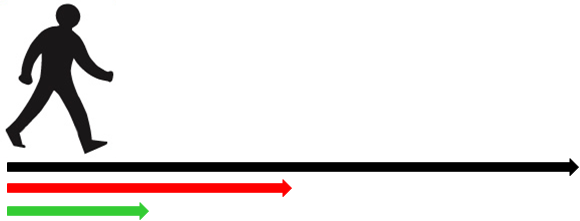
I’ve recently been looking into Zeno’s Dichotomy Paradox. To simplify it in an awkward fashion, imagine walking a distance. Say the exit of a supermarket to wherever you parked your car. Now that is a set distance with a set time but to get there you will need to reach the halfway point first. However, if you’re going to split distances in half, you might as well split that halfway point in half too, and its subsequent halfway point in half and so on and so forth. Now if you add up all those new split distances, the sum total would be infinity. After a moment’s consideration, the overall distance between the supermarket and your car becomes impossibly long.
            Now this paradox is easily refuted by mathematical thinking but that’s not what I’m concerned with today. I’m more interested in the kind of mindset where the Dichotomy Paradox is almost always a problem. In short, anxiety.
            I am an anxious person. I worry about great distances before I’ve even begun the journey. I imagine every distance beyond the footpath to town or to work is a great distance. It’s a journey fraught with potential perils at every step from genuine niggles like losing my bearings and having to rely on the kindness and accuracy of strangers, to outrageous fears like my glasses flying off my face and landing in the middle of a busy road. Like in the paradox, every step of the way contains a new obstacle and hold-up.
            Normally all it takes to get over this fear is to set about moving forward. The thing about the Dichotomy Paradox when applied to real life is that it is undermined by actually crossing the distance. Calculations and halving are all well and good but they are nothing compared to the human tendency to just get on with the task at hand. It’s really that simple and yet remains very easy to forget.
            Now perseverance is always easier when you know what’s at the end of the road, when you ultimately realise that very little will change as a consequence. You can fight back the concept of the Dichotomy Paradox if the task is something that won’t take long and won’t result in the end of a life or a way of life. In those harrowing circumstances there will be days when the Dichotomy Paradox will just tie you up in knots and paralyze you with fear. After all, the certainty of disappearance doesn’t bear thinking about.
            Nevertheless, my suggested workaround for this is to bypass the multiple potential measurements in that distance with our feet. Change is scary but sometimes we go through the motions of routine behaviour and motor memory and suddenly we're well past the problem. If there was ever really a problem to begin with.
            I would say Zeno’s Dichotomy Paradox is something to think about now we’re in a new year and decade. It’s something to acknowledge and hopefully overcome.

Thursday, 26 December 2019

A CHILD'S BOXING DAY IN ENGLAND (a.k.a. A Remembrance of Post-Christmas Transition Days Past)


One Boxing Day was so much like another, in those years of small responsibility and not much to worry about.
All the Boxing Days roll into one as I remember pitter-pattering barefoot down the stairs to grab a bowl of cereal and the leftover tangerine from Santa’s stocking. It was quiet but not exactly peaceful with all the presents scattered around the living room still to put away but this was still technically Christmas for me and the rest of the family were asleep so why bother rushing?
I would eat my small breakfast by the computer table, turning the swivel chair to see the heated trays on the dining table just behind me, still full of vegetable spring rolls and prawn vol-au-vents. The greasy smell pervading from the kitchen would remind me that there was still the Beef Wellington to finish, something I had nibbled at the previous night rather than scoffed. However, if the stringy brown slices were to be put in a buttered bread bun that day, I wouldn’t say no.
Once the last segment of tangerine had been swallowed, down came mother who was then followed by sister and eventually father. We would find there wasn’t really much left to say after all the exuberant ‘thank you’s of yesterday so we would instead begin a slow and steady tidy up of the living room.
All my presents: books, DVDs and action figures would be dumped on my bed where I would fiddle with them some more and lose a good twenty minutes contemplating the points of articulation of this Doctor Who figure or really how little I wanted to watch this film that I asked for in earnest.
Then I would dress myself properly, brush my teeth and descend the stairs to find the kitchen occupied with the whirr of the oven heating up leftovers and maybe the hob being click-click-clicked on. The kettle would already be boiled for the parents and perhaps my sister but I would have what was left of the milk bottle once the teas and coffees had all been poured.
Food would then be transported back to the heated trays on the dining room table and we would stack a small china plate each with those spring rolls and vol-au-vents as well as mini-pizzas, breadsticks and crisps. I would always fill up with more crisps than substantial food and had a tendency, when eating battered shrimp, to swallow the tail too.
Then, when I was fit to burst and queasy with all the salt and grease, I would supplant myself on the toilet for a long stretch, both out of necessity and for the me time. If it occurred to me, I may have even started reading one of my presents even if that was only the back of a DVD box.
Outside wasn’t usually worth visiting, a stiff white sky that occasionally cracked and let through a fine winter drizzle. Still, with all the hustle and bustle indoors, any chance to step out was ultimately a good thing even if I only managed to snatch a handful of shallow breaths of chill air. Then I would return to find everyone in the living room, watching whatever animated feature was on, Dreamworks often after Disney. There would be some buzz as the TV guide was handed round, at the prospect of the special episode of whatever show was popular at the time being on that evening. We would set our eating schedule around that then break off from family time, some of us to wash up, some of us to tidy away presents, and me to visit the toilet once again.
I often lost track of time, Boxing Day being so slow, and I would look up and wonder why I was being called back downstairs. Then I would wander into the kitchen to find Beef Wellington slices being packed into bread buns and found that that would be the main course for dinner. Of course, it did turn out to be dinnertime or perhaps half an hour earlier than usual.
I would hunker down and eat, grabbing a fresh plateful of snack foods to fill out the meal, watching whatever was on the telly before returning to the kitchen to begin washing up. We didn’t have a dish washer for a long time so it was up to me and my sister to make sure the fancy wine glasses we only ever brought out at Christmas were sparkling clean and ready to return to the dusty wooden display cabinet. Then father would empty out the heated trays and give us them for ‘a quick wipe’ but I always gave them more attention, at least until there were no visible suds left. Then, if the snacks were sufficiently depleted, the trays and the heater were all boxed up and put at the very top of a tall set of shelves. Dad would deal with this, with some assistance from me when I was tall enough.
Then in the gathering dark, we would seat ourselves in front of the TV once again and spend a little more time watching the latest DFS sale advert and glancing around at the Christmas decorations, determining when they were to be taken down and in what order.
By now I had opened my chocolate selection box and started working my way through a mini bag of Maltesers and perhaps a single Twix bar because there really was little else to do. Boxing Day didn’t make much sense when it came down to it, other than to be a transition day between Christmas and shops re-opening. The older I got the more I realised the disappointing mayfly that Christmas Day was, after the long run-up, after the hysteria those same shops and the TV had caused. It seemed a lot of exhaustion for a short period where presents were torn open and expectations were met. And Boxing Day? That was merely the day when the wrapping paper was stuffed into the recycling bin.
Nevertheless Boxing Day got away from me soon enough and I was back to bed, watching a film I had recorded instead of one of the DVDs that had been gifted to me. When that was over, I muttered some happy nonsense about doing things better next year, and then I slept.

Friday, 20 December 2019

A SEASONAL LYRIC CRITIQUE (a.k.a. Wizzard's I Wish It Could Be Christmas Everyday is Snow Joke)


When the snowman brings the snow…

Let us unpack this. Sort of reverse engineer the snowball, as it were.
            A snowman is traditionally a humanoid depiction made from fresh snow. Therefore the snowman is snow. The only snow that the snowman can technically 'bring' is the snow of which he is composed.
            However, the snowman also tends to be immobile. So no act of bringing is in fact possible, at least not in the physical sense.
            He might, for the sake of argument, 'summon' the snow. By this I mean will the very substance of life, his life at least, into being. In this particular scenario, the snowman is more of a 'snow sage' or a 'winter wizard' if you will. Suffice to say I have yet to come across such a powerful snowman.
            That leaves us with a conceptual meaning. The snowman’s mere existence brings the thought of snow into the mind of the observer. This is by far the most straightforward explanation. That being said, it is still specious: unless the observer’s view is somehow limited to only the snowman and not the probably large bed of snow underneath. This would require a 'Plato’s Cave' level of logic.
            Nevertheless, I highly doubt that the lyricist strove for that particular degree of realism. Still one would expect more of Roy Wood. If a Christmas song is worth writing then it is worth writing with proper and thoroughgoing attention to detail.
            Incidentally, Merry Christmas Everyday, I suppose…

Saturday, 12 October 2019

TODAY AT A CAFE (a.k.a. A Nonfiction Experience from Actually a Few Weeks Ago Now)


The café was all black granite top tables with padded white stools and booths that were difficult to slide into from the eyesore diamond tile floor. Still, it was clean. As I approached the main counter, the man behind it spied me as I passed by an interior design topiary.
            “Hi there,” he began. “Today we have a special deal on curry and rice. You can buy the Jalfrezi, Tikka or Korma for just £6.”
            I nodded along as he showed me the contents of each steel container on the heated display. I looked back up and said, “Can I order a hot chocolate please?”
            He gave out a whiny little laugh but turned towards the steamer behind him. “Is that with whipped cream?”
            “Yes, please.”
            “That’ll be £2.80.”
            As I passed him a fiver, a skinny waiter with a fat yellow tie stopped beside me.
            “Bored,” he announced. The man behind the counter grinned in response. The waiter caught my eye. “And how are you today, sir?”
            “I am fine, thank you. How are you?”
            “I am well. As well as I can be working with this kidder over here.” He gestured at the man behind the counter as he handed me my change. They both giggled. “And what will you be doing after your drink, sir?”
            “Go home.”
            The waiter nodded. “Do you play computer games?”
            I hesitated. “Sometimes. Not as much these days.”
            “You look the intelligent sort. Would you say you’re intelligent?”
            I frowned but laughed it off. “That’s not really for me to say.”
            This was not the most comprehensive of answers. I waited for the interrogation to continue but then the waiter turned, apparently called over.
            “Sorry about that,” the man behind the counter said.
            “That’s all right,” I lied.
      I sat on the opposite side of the topiary, using it as a green leafy window to the only other customer in the building. She tucked into a panini, knife and fork tearing through the thick bread. Her eyes were damp and she had to stop a moment to wipe away the tears. The waiter appeared with fresh napkins for the table which he handed to her personally. Her wedding ring glistened in the light as she touched one of the stiff brown sheets to the corners of her eyes.
"Poor dear," the waiter muttered before moving off in the direction of distant clattering crockery.
I felt bad for looking at the woman so I stopped. Nevertheless, she watched me carefully until she finished her panini.
The man behind the counter came to bring the hot chocolate over to me himself. There was a small biscuit on the saucer. "No extra cost," he said with a smile before returning to his post.
I then took out my phone and lost myself in my emails. Halfway through my hot chocolate, I heard the waiter reappear at the counter.
“Bilal's got a chicken bone in his throat," he told the man.
"Is he choking?"
"Go see for yourself."
The man came out from behind his counter once again, this time in a definite rush. Barely a minute later a short woman with a beehive hairdo arrived to take his place.
"How are you today, sir?" she asked me. I gave her a thumbs up as I crunched my biscuit. 
Raising my phone again, I finished composing my last reply then emptied my cup. I left behind a small crumbly corner of the biscuit. In the meantime, the man had come back and he, the woman and the waiter were all busying themselves behind the counter, all getting in each other's way.
"Thank you," I said. None of them turned to me. A little flimsy wave and I was away, out of the door.
I'm afraid I didn't have the wherewithal to compose a thorough review at the time. Something tells me this here will suffice.