I (sometimes) call myself Mr. Pondersome. I'm a rather wordy, weirdy person. I say hullo a lot. I write a lot more. While you're here, why not give some of it a read?
Showing posts with label writing. Show all posts

Saturday, 3 October 2020

Idle Pretention (a.k.a. Learning from My Lazy Student Days)

 After a bit of a tidy-up, my Mum found this sheet.


Holes with Flaps was a story that I wrote during my time at university. It was part of a flash fiction collection that I submitted for a short story module.

            The story itself is curious but re-reading the rather faint pencilled comment from the marking tutor really struck me. For one thing it is a rather generous critique for a flimsy and thematically embarrassing piece of writing but it also includes two words that have followed me around for many years. These are ‘poignant’ and ‘ambiguous’.

            ‘Poignant’ is one of my favourite adjectives to describe anything that makes me go hmm. Unfortunately it took me a couple of years to actually learn its precise definition, which is a strong and often sad effect of feelings. Here I was thinking it meant incredibly intelligent. Must have got it mixed up with ‘profound’.

            Nevertheless I have always intended to write stories that are poignant and profound. This is a foolhardy endeavour but has taken me just over a decade to realise the fact. I had an inkling as far back as 2010 that what I was putting to paper wasn’t quite as clever as I hoped it would be. Indeed my love of quirks and gimmicks in fiction doesn’t necessarily lend itself well to writing in the styles of Raymond Carver or Alice Munro. I tried regardless and had some occasional successes, Holes with Flaps not being one of them. Prior to rediscovering this sheet, I had all but forgotten the story.

            The other adjective ‘ambiguous’ is precisely the reason why these stylistic experiments rarely worked. Not enough meat on the bone. At university I learnt that the coolest short stories were the ones that were plain-speaking with short punchy sentences that only highlighted details the reader absolutely needed to know. I came to overlook the nuance of clear character development and mood-changing setting description. I neglected playing with a unique idea over multiple paragraphs, for fear that explanation would counteract a Hemingway-like honesty.

            While ambiguity was the common complaint, only I knew what it really was: laziness. Pure and simple sloth. I didn’t want to put in the hard work to make a story truly meaningful and memorable, I just wanted it to stand out. And it did though usually for all the wrong reasons. Oh sure, there was a poignance to some of those stories but it lacked depth and definition. In fact, you could say that there was a big ambiguous hole in my stories that was disguised with a thin flap of poignant expression.

            Now it’s not for me to say if I have developed much as a writer since then but I like to think I pad my stories better. If there are any conceptual tears, I try to sew them up and hide the stitching. It’s a lot of work but worth it. With every story I write now, I actively move away from idle pretention. It would be lovely one day to write something that combines gimmick, genre, philosophy and simplicity; something that sticks in a reader’s mind. Still that could take years. Another decade perhaps.

            Once upon a time I persevered blindly. I genuinely thought that stories like Holes with Flaps were erudite and enlightened. Since then I have added observation and self-awareness to that perseverance. I still create tales that fail to connect but I learn from them. That is the wonderful thing about keeping on with creativity through one’s life. You slowly shrug off idle pretention and grow up.

Wednesday, 24 June 2020

Out in the World with a Chunky Blue Jotter (a.k.a. What Actually Happens When You Write in Public Places)


Pub

I grabbed a seat in a busy pub and waited for a friend. He wasn’t late, I was early. Still I was concerned we wouldn’t be able to hear each other over the laddish din. Even the short bar stools were occupied by people spilling their pints on the varnished circular tables.
            Across from me sat three lads sharing a phone. One in a maroon rugby jersey was holding off about some ‘fat bird’ he knew in his nasal Geordie accent. He thumped the shoulder of the lad who was holding the phone, seemingly just for the hell of it.
            By this point I had taken out my chunky blue jotter and was distracting myself with a jokey story about the Trolley Problem.
            It took the Geordie lad a moment to notice this. “Harry Potter over here,” he muttered. He meant the glasses as that was the only similarity between me and the boy wizard.
            “Hey, mate,” he said. “What you writing?”
            “Something for work,” I lied.
            “What’s it about though?”
            “Nothing of interest.”
            Though he still had on his open mouth smile he clearly wasn’t happy with that answer. “Seriously though, what you writing?”
            I paused and looked him in the eye. “Work, you know?”
            He would have asked a third time had the phone holder not thumped him back. It occurred to me the Geordie lad thought I was writing about him and his mates or maybe even the ‘fat bird’ they just had been discussing. Perhaps I should have been more open and honest but I really wasn’t in the mood to justify myself to a nosy bar fly.
            My friend arrived shortly after that and supplanted himself between me and Geordie lad who had fortunately lost all interest. He announced to the whole pub that they would move on to a nearby alehouse and make a proper night of it. I was glad to see him go.
            A frustrating experience but, most frustrating of all, I didn’t get back to my story. The Trolley Problem had run away without me.

Café

I hid away in a café that itself was hiding from the high street. I settled at a granite top table beside an oak staircase and ordered a hot chocolate with all the trimmings.
            Having brought my chunky blue jotter, I started outlining a plan. The idea was thin, about a printer that printed dreams, but I made it work with two creative characters. Sometimes that’s all it takes to be inspired.
            The short blonde manager in a comfortable green hoodie stood behind the counter's cake display and grinned warmly at me. “Are you a writer by any chance?”
            “Yes.”
            “Is it a dissertation?”
            “No. I’m not a student.”
            “Oh. So you’re a creative writer?”
            “Yes.”
            “Excellent.” She seemed genuinely pleased. “Well, I’ll leave you to it.”
            Such interruptions can put me off my stroke but not that day. The sun was shining and the background chatter was moderate. Soon enough I had finished the plan and had started the story itself.
            A meeting broke up and a tall black-suited man with thinning brown hair stopped beside me.
            “Sorry to bother you but I’ve never seen anyone write so fast before.”
            “Thanks.”
            “Well. You do remind me of a lad I used to know. He had fast penmanship too. Hand-wrote his entire dissertation. Is that what you’re doing?”
            “No. I’m not a student.”
            “A creative writer then. Published?”
            “Some places. Not many.”
            Nevertheless he seemed genuinely interested. He offered me his hand to shake. “What’s your name if you don’t mind me asking?”
            I told him. He repeated it though if he was actually committing it to memory I do not know.
            “Right. Well I’ll look out for you on the shelves.”
            Another, more substantial interruption but I didn’t mind. The sun was still shining and the background chatter had diminished even further with his exit. Besides I had been rather sweetly complimented. The manager must have noticed the little smile playing on my lips as I sipped my hot chocolate.
            “Our own resident writer,” she said with a chuckle.
            I’m afraid I haven’t been back since.

Wednesday, 3 June 2020

What I Have Learnt from Writing Guides (and What Actually Sticks)

There are so many writing guides out there. Too many, some would argue.
            I personally enjoy reading a variety of perspectives on what constitutes good writing. While ‘how to’ guides can irritate with single-minded arrogance and even intimidate with the rigidity of the ‘rules’ they set, all that is really important is that you find at least one idea that you like and want to implement.
            Over the years I myself have come to look on every ‘definitive’ guide as an orchard from which to cherry-pick the juiciest stylistic suggestion. A lot of these books contain a variation on classic advice (e.g. show don’t tell, ‘said’ is the best speech tag, step-by-step plans etc) but sometimes the author shares a suggestion that is uniquely appealing. These are often small and based on personal quirk but if it works for you then it’s made for you.
            That being said here are three writing guides that have gifted me with tricks and techniques that I still use to this day:

Reveal Character or Advance Action – 8 Rules for Writing a Short Story


While this is strictly speaking a short list, it has still proven an invaluable guide to the way I approach writing.
            Of the eight rules, the most important to me is ‘4. Every sentence must do one of two things – reveal character or advance the action.’ It’s obvious when you think about it: what purpose does a fiction sentence really serve if not to tell us something we need to know?
            Consequently a big part of my editing process now involves going through each sentence of a short story or chapter and marking them green if they advance action or yellow if they reveal character. Then I go back over the sentences left white and get rid of them. It can get fiddly but it is truly rewarding to see whole paragraphs of green and yellow sentences, knowing that not one has been wasted.

The Curse of Knowledge – Wired for Story by Liza Cron


In Wired for Story, Liza Cron shares a cognitive approach to reader relationships with the text and how a writer can make best use of it.
            One of the concepts that she shares is Chip and Dan Heath’s “The Curse of Knowledge” which they describe as ‘Once we know something, we find it hard to imagine what it was like not to know it. Our knowledge has ‘cursed’ us. And it becomes difficult for us to share our knowledge with others, because we can’t readily re-create our listeners’ state of mind.
            This provides an essential insight into why some writers fail to connect with readers. It certainly goes a way towards explaining my early years where I wrote disconnectedly, hoping that the reader would do the work for me. Cron’s book dismisses such thinking in no uncertain terms: if you don’t convey the full story, the reader will just put it down and walk away. They are under no obligation to stick around until it gets better.
            I like studies that confirm how readers generally interact with a story, they provide a swift kick in the pants for lazy kids like I was.

The Cosmic Sentence – Why Will No-One Publish My Novel? By Fay Weldon


Every story needs a reason for existence, something that can be summed up in a single elegant line. Every fairy tale has a moral and every scientific study has a hypothesis.
            For those who are dismayed, I once thought this sacrilegious too. How can one possibly condense a nuanced story wherein so much is going on? It has taken me a while to realise that no story is too complicated to summarise. Indeed, if you can’t, then how will you ever sell it?
            This realisation was cemented by Weldon’s hype about the cosmic sentence ‘that sums up the thought that started you off, the idea that caught you all of a sudden, the emotion you were trying to validate, the point you were trying to prove.’ When put like that, you can’t deny that every piece of fiction has some kind of cosmic sentence at the heart of it.
            You might say the cosmic sentence of Herman Melville’s Moby Dick is ‘revenge is fatal for all’. The cosmic sentence for The Hobbit by J. R. R. Tolkien is arguably ‘adventure enriches the soul’. Mary Shelley’s Frankenstein has part of the cosmic sentence in its subtitle: ‘the Modern Prometheus’.
            I can’t say how many times I have caught myself wandering off point with a story and dragged myself back to the original cosmic sentence. It is my best focus.

***

Suffice to say, most of the inspiration I have drawn from writing guides is for editing and rewriting. These are the two aspects of the process that I find hardest and I’m sure I’m not alone in that.
            Being disciplined is hard and so the mind naturally seeks distraction. I would argue that reading writing guides is the most effective way to distract yourself. Still mind you don’t stop writing because you’d rather be reading writing guides. I find them oddly addictive and so read them only occasionally.
            At some point you need to get out of the cherry orchard. It’s tempting to fill your basket but then you may never fill it to satisfaction. Instead take those cherries, those ideas, and make something from them.

Friday, 29 May 2020

Comma Press Dinesh Allirajah Prize for Short Fiction 2020 Update (a.k.a. Publication!!!)

Comma Press - Northern Fiction Alliance

Following my previous announcement about being shortlisted for the Comma Press Dinesh Allirajah Prize for Short Fiction 2020, I have news.

While I did not win this time (that honour goes to JE Rowney and her marvellous short story Protect and Serve), I have been included in a Comma Press ebook publication collecting all five short story on the shortlist.

This is titled Comma Press Dinesh Allirajah Prize for Short Fiction 2020 AI Stories. As of publishing this post, this ebook is available from the Amazon Kindle store at 99p!!! If you are curious to read Protect and Serve, The Problem Unit and all the other excellent stories, please click the following link: 

https://www.amazon.co.uk/dp/B085S922PM?fbclid=IwAR3D4qs7ESP5Ka8tPMuuapDVRXFMkCANcMgQY9RTvIUrHmim5V9cvOHvjuY

If you want to hear a bit of my story The Problem Unit, here is a video of me reading an extract from the middle of the story (no spoilers):

https://www.youtube.com/watch?v=AdIyAZHCSO0&t=9s

I want to thank Comma Press again for honouring me by including my story in the shortlist and publishing it in AI Stories. It's been an awesome experience!!! 

Tuesday, 8 January 2019

THE MAUDLIN CHARM OF KAREN EIFFEL (a.k.a. A Profile of a Fictional Author)

Image result for karen eiffel gif

     Karen Eiffel is a bestselling novelist.

     Her body of work consists of Detractors of the Living, The Widow's Calendar, Grieving, The Poetry of Trainwrecks, Four Black Veils, The Agony of Everything, The Muffled Traces of a Boyish Laugh and now Death and Taxes.


     Noted literary critic Max Weller describes Eiffel as 'a new standard for English-speaking authors...a touchstone set too low.'


     Eiffel does not correspond with fan mail. Both in and out of her fiction, she has 'maudlin charm'. When asked on the Darlene Sunshine Show if her glass is half-full or half-empty, Eiffel simply replied 'I keep knocking it over.'


Image result for karen eiffel gif

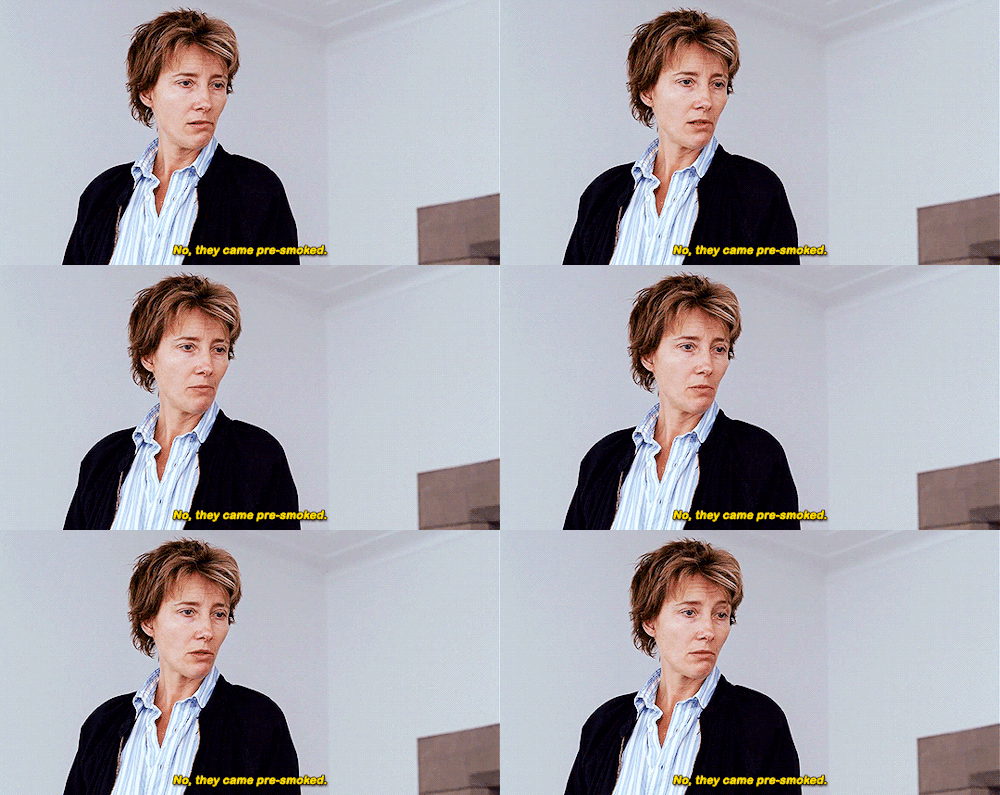
     Karen Eiffel herself is a fiction. She is a character created by Zach Helm, Marc Foster and Lindsay Doran and brought to vivid life by the incomparable Emma Thompson in the 2006 Columbia Pictures film Stranger Than Fiction.

     We are first introduced to Eiffel in blue and white striped pyjamas and a black cardigan that has seen better days. Like most cinematic depictions of genius writers, Eiffel is blocked. She smokes cigarette after cigarette and disposes of them in crumpled tissues dampened by spit. She is really not doing well.


     Then again it must take a depressive mindset to bring eight likeable characters to life just to murder them in beautiful and poetic ways. These include Edward, a civil engineer who suffers a heart attack during rush hour and Helen, a schoolteacher who passes a day before summer vacation.


     Eiffel's latest victim will be Harold Crick, an IRS agent though how his fate will be sealed eludes the author for the moment.


     Even so Death and Taxes is due to Banneker Press and they have sent out Penny Escher, a no-nonsense assistant to apply structure to the ongoing issue.


     However poetry and index cards will not do in this case. To Eiffel, writing should come 'inexplicably and without method.' Then again this does not preclude the following of whims such as seeking doomed patients in hospital emergency rooms or reading 'fantastically depressing' books about suicidal leapers.


     Eiffel is herself a woman in free fall. Her only notable solace comes from the letters of Literary Theory Professor Jules Hilbert, to whom she presumably cannot bring herself to respond.


     It seems that Eiffel needs a shock to take her out of her head, a startling revelation of some kind. A grand epiphany.


     Little does Eiffel know, epiphanies can come from imagining the epiphanies of other people.


     After all, there is great power in fiction: something so strange that it can even change the truth.


Image result for karen eiffel gif

The character Karen Eiffel and the film Stranger Than Fiction (2006) are the intellectual property of Columbia Pictures. This essay does not claim ownership of either.

Sunday, 12 June 2016

WRITING ON WRITERS (a.k.a. Advice to Absurdity)

Writing is like eating spinach whilst doing cartwheels.

Writing is responding to a pillar box.

Writing is wondering why only one half of the chimney is wet.

Writing is like pretending you're a goat herd when really you're a cow herd. Same height.

Writing is the exact same thing as thundering.

Writing is a synonym for helmet hair.

Writing is artfully melting an ice cub between two oven gloves.


Writing can and should be wroting.

Writing should never be Bob Newhart in his best beret.


Writing is just like adapting in a half-chewed shoe box.


Writing is a Glaswegian Penelope.

Writin g is w riting.


Writing is the third vestige of the sarcophagus-eclipsed.


Writing to flick off elves is glib.

Writing at a Tuscan tugboat is surely prescient.

Writing should be in the prescient tense.

Writing with zebra-striped ifs is a crux.


Writing after Thursday 3rd makes your turban horny.

Writing before the Figgy Wives Club is a charitable implosion.

Writing towards talcum powder rations.

Writing away from the interviewer's garden nozzle.

Writing poetic haymakers.

Writing prosaic blue handles.

Writing out of the frog's clammy gulag.

Writing inside the Pollack door frame.

Writing somewhere Fallopian.

Writing somewhere among the woodchip.

Writing somehow to stammer Howarth Howard.

Writing as a a gnitriw.

Writing with an eye gouge.

Writing without a Teresa CD.

Writing because of ample sideburns.

Writing is like form-fitting form-filling.

Writing is just about kebabs at dawn.

Writing is like perishable trapeze glands.

Writing is rockstar huh